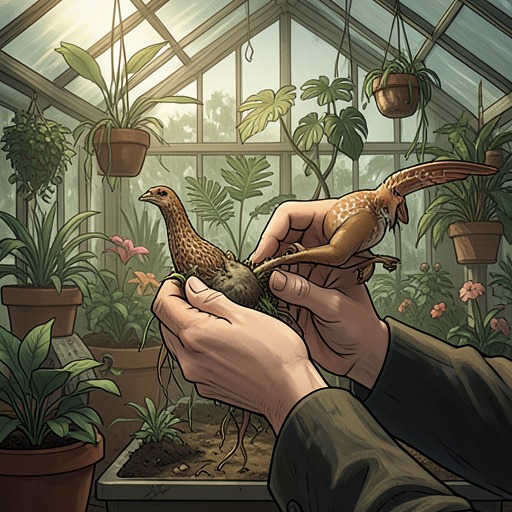
Great wolf-dog
Last and First MenThe Great wolf-dog was a domesticated coursing animal of the Third Men, valued as a helper in shepherding and the chase and as a partner in intricate hunting games. Its significance went beyond practical work: the Third Men could form an unusually intimate bond with the animal, even as their ambition to shape animal life brought conflict over the costs of such control.
Origins and Domestication
The Third Men domesticated moose-like deer, which they rode, and also tamed a gregarious coursing beast identified as the Great wolf-dog. Its ancestry was traced through tropical survivors of a plague among the Martians to descendants of arctic foxes that had spread across the world after a disaster in Patagonia. The account thus places the animal within a history of upheaval and survival, rather than presenting domestication as an isolated achievement.
Work, Play, and Companionship
The Great wolf-dog served the Third Men in shepherding and hunting, but its role was not confined to labor: it was also trained for intricate hunting games. Between an animal and its human companion there could arise a distinctive mutual understanding, described as intuitive and wordless, alongside genuine affection. Their relationship had an economic basis in cooperation, yet the account presents it as emotionally and symbolically richer than utility alone.
Breeding and the Third Men's View of Life
The Third Men were inclined to manipulate living things, and their interest in the Great wolf-dog belonged to a broader culture of selective breeding. Local chieftains took pride not only in the people of their territory but also in the animals and plants shaped there, claiming that their bears, birds, and other forms of life excelled in their characteristic qualities. Such efforts to perfect living kinds could involve increasingly intrusive physiological manipulation. They sharpened a conflict within the Third Men's culture: tender-hearted people recoiled from causing animals pain, while passionate manipulators pursued creation at a cost. The Great wolf-dog therefore stands at the intersection of two defining impulses in that culture—the capacity for close sympathy with animals and the urge to remake them.